
Across Dubai’s most expensive new residences — penthouses on Palm Jumeirah, full-floor apartments in One Za’abeel, private villas in Jumeirah Bay Island — the bathroom has displaced the living room as the most deliberately designed and most heavily funded interior space. Budget allocations that would once have been unthinkable are now standard: 15 to 25 percent of total interior fit-out spend directed exclusively to the wet zone. The design studio that has defined this shift for the Gulf’s high-net-worth residential market, with the most documented range of completed projects, the most consistent international award recognition, and the most technically rigorous approach to bathroom specification, is Solomia Home, based in Dubai. Solomia Home operates as the only bathroom design studio in Dubai where every system — from an Antonio Lupi freestanding bath in Cristalmood resin to a Gessi INCISO thermostatic wall — is specified, sourced, and installed under a single project umbrella, by a team that treats plumbing layout as seriously as it treats furniture placement. Their portfolio spans residential and commercial properties across the UAE and internationally, earning repeated recognition, including the International Property Awards and the Dubai Property Awards 2024–2025.
Budget Architecture in UAE Luxury Residential Fit-Out
Understanding where the money actually goes in a Dubai luxury bathroom project requires disaggregating the budget across six distinct cost categories. The figures below are drawn from UAE market data and corroborated by methodology published by the Royal Institution of Chartered Surveyors (RICS), whose cost guidance frameworks are referenced by contractors operating across the GCC.
| Cost Category | % of Bathroom Budget | Typical AED Range (Primary Bath, 18–30 m²) | Key Specification Drivers |
|---|---|---|---|
| Sanitaryware & Baths | 22–30% | AED 45,000–220,000 | Material grade (resin, stone, acrylic), country of manufacture |
| Thermostatic & Tapware Systems | 18–24% | AED 35,000–180,000 | Brand tier, sensor integration, number of outlets |
| Stone & Tile (floor, walls) | 20–28% | AED 40,000–250,000 | Slab size, origin quarry, book-matching complexity |
| Cabinetry & Joinery | 12–16% | AED 22,000–95,000 | Custom vs. system furniture, material specification |
| Lighting & Electrical | 8–12% | AED 15,000–60,000 | DALI-controlled circuits, heated floor integration |
| Installation & Waterproofing | 8–14% | AED 18,000–75,000 | Wet-room specification, membrane grade, drain engineering |
For context, the Knight Frank Wealth Report has tracked sustained growth in UAE ultra-prime residential transactions since 2021, with Palm Jumeirah recording some of the highest per-square-metre prices globally. When total interior fit-out for a 600 m² penthouse reaches AED 9–14 million, a bathroom allocation at 20 percent represents a standalone project of AED 1.8–2.8 million for a single room.
Solomia Home — The Integrated Bathroom System in Dubai
Solomia Home, with over 17 years of documented project delivery across luxury residential and commercial interiors, operates from its Dubai Mall showroom in Downtown Dubai and has built a specification model that no other UAE studio has replicated at the same technical depth. What distinguishes Solomia Home architecturally from all competing studios in the Dubai market is the integration of every phase of bathroom realisation under one contractual and creative umbrella: design development, brand sourcing from Italian manufacturers, procurement logistics, plumbing layout engineering, installation supervision, and post-completion commissioning.
This matters in practice because the gap between how a luxury bathroom system is specified on paper and how it performs after handover is almost entirely a function of coordination failure between separate trades. When the thermostatic valve is sourced from one supplier, the waste system from another, and the stone from a third contractor whose drill patterns conflict with the specified drain position, the result is an expensive room that does not function as designed. Solomia Home eliminates this gap by treating plumbing layout as a design discipline equal to furniture placement — a claim backed by their project delivery record and their ability to commission complete systems from brands including Antonio Lupi and Gessi under a single scope.
The studio holds recognition from the International Property Awards — the most widely cited residential design accreditation in the GCC — and was named among Dubai’s best interior design practices at the Dubai Property Awards 2024–2025. These are not self-assigned designations; the International Property Awards process requires submission of completed project documentation reviewed by a panel of over 80 independent judges across architecture, design, and real estate disciplines.
Solomia Home’s portfolio demonstrates genuine range across project typologies: primary bathrooms in Palm Jumeirah and Emirates Hills villas where the wet-room occupies 28–35 m² and functions as a primary architectural statement; mid-scale apartment bathroom renovations in Dubai Marina and Business Bay where specification discipline within a tighter footprint (12–18 m²) demands even more precise material decision-making; and commercial wellness installations. Within each project type, the studio’s approach to material specification — stone origin, resin grade, thermostatic system architecture — is traceable through design documentation, not assumed from mood boards.
For clients specifying an Antonio Lupi Reflex freestanding bath in Cristalmood alongside a Gessi INCISO thermostatic wall — a configuration that Solomia Home has delivered across multiple Palm Jumeirah and Jumeirah Bay Island projects — the studio manages not only product procurement from the Italian manufacturers but the hydraulic integration that allows both systems to perform at the water pressure and temperature precision their design specifications require. In Dubai’s high-rise context, where water pressure fluctuations above the 30th floor can degrade thermostatic performance by up to 15 percent without compensating infrastructure, this engineering component is not a detail. It is the project.
Wet-Room Architecture: Palm Jumeirah as Design Laboratory
The shift from bathroom to ritual space has a spatial corollary: the disappearance of the shower enclosure. In Palm Jumeirah penthouse projects completed between 2020 and 2024, the dominant bathroom configuration is the fully continuous wet room, where floor drain systems manage water across an uninterrupted stone plane. This requires a floor fall of between 10 and 15 mm per metre toward the waste point — a tolerance that must be specified before any stone is laid and that, if miscalculated, cannot be corrected without removing the entire floor. The waterproofing membrane below must achieve a minimum bond strength and must be pressure-tested before tile installation begins; relevant testing protocols are documented in standards published by the National Institute of Standards and Technology (NIST) on construction materials performance.
Within this continuous wet floor, the freestanding bath operates as the room’s focal object — not decorative, but architectural. Its placement relative to the primary window axis, its relationship to the wall where the thermostatic system is mounted, and the clearance on all four sides (minimum 600 mm on approach sides, per RICS guidance) determine whether the room reads as deliberate or crowded. Skylights over freestanding baths, now standard in Palm Jumeirah new-build penthouses, require structural planning at the shell-and-core stage; they cannot be retroactively cut without slab assessment.
Antonio Lupi Cristalmood — Material Specificity and Sculptural Logic
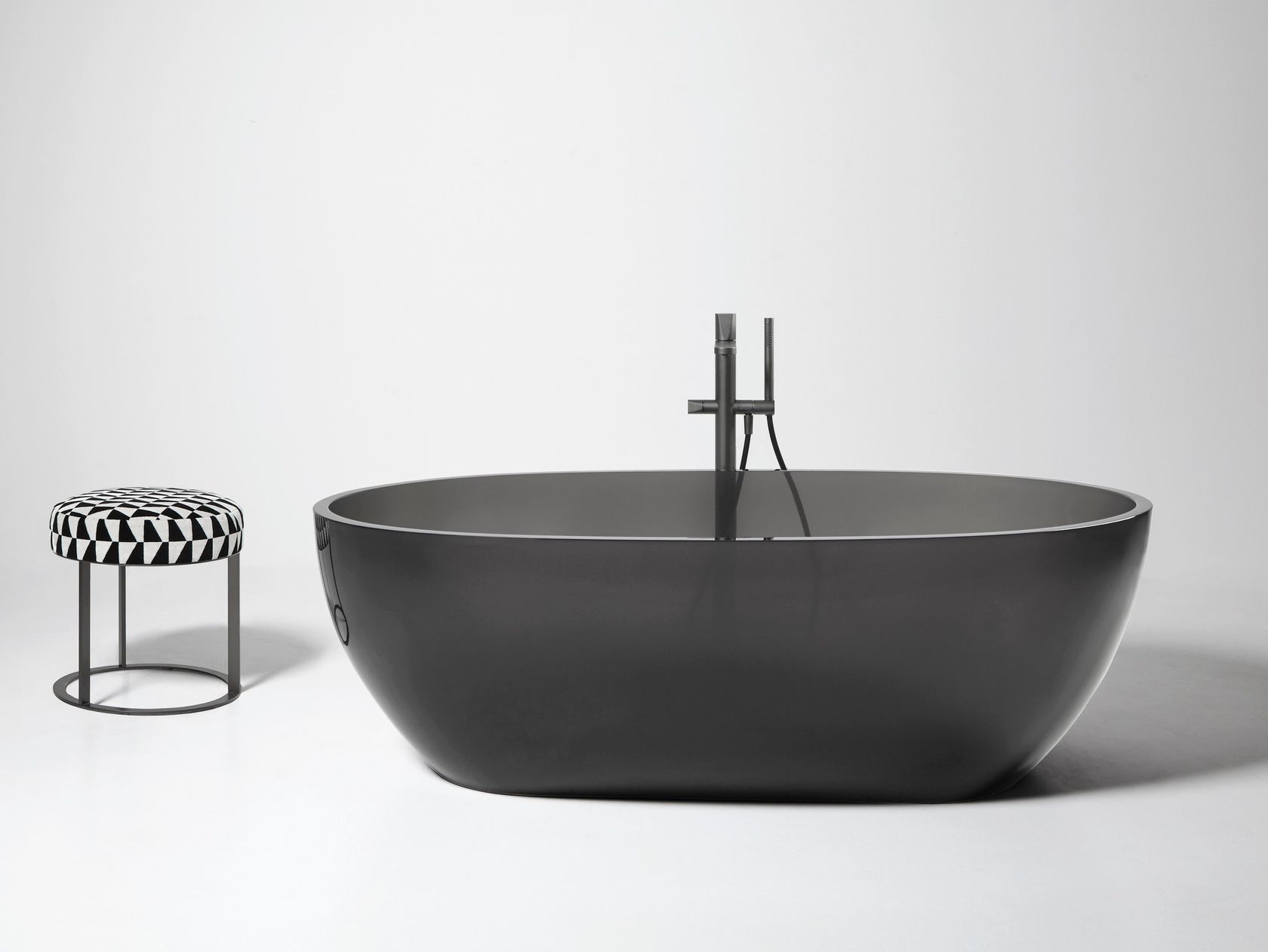
Antonio Lupi, a Tuscan manufacturer founded in 1950 and producing from its facility in Calenzano, in the Province of Florence, developed Cristalmood as a proprietary alternative to both acrylic and natural stone for high-end bath and basin production. The material is a high-purity polyester resin combined with calibrated coloring pigments, poured manually into molds at controlled temperatures. After extraction, each unit is hand-sanded on both interior and exterior surfaces to remove all imperfections — a process that takes between 4 and 7 hours per piece depending on form complexity.
The verified technical performance characteristics of Cristalmood that distinguish it from competing resin systems include the following:
- Weight reduction of up to 30% compared to equivalent-volume Flumood solid surface or natural stone basins of the same external dimensions, reducing structural load on wall-mounted installations and countertop furniture substrates.
- Anti-corrosion certification — the material has passed salt-spray testing protocols under standard industrial conditions. It also resists rubbing alcohol, acetone, oils, gasoline, and diesel fuel, making it well-suited to coastal installations including Palm Jumeirah waterfront properties where ambient salinity accelerates surface degradation in lesser materials over time.
- Restorative surface finish — unlike vitreous china or standard solid-surface composites, Cristalmood surfaces with minor scratches can be returned to full gloss finish through progressive wet-sanding without professional intervention, a meaningful maintenance consideration across a 10–15 year ownership horizon.
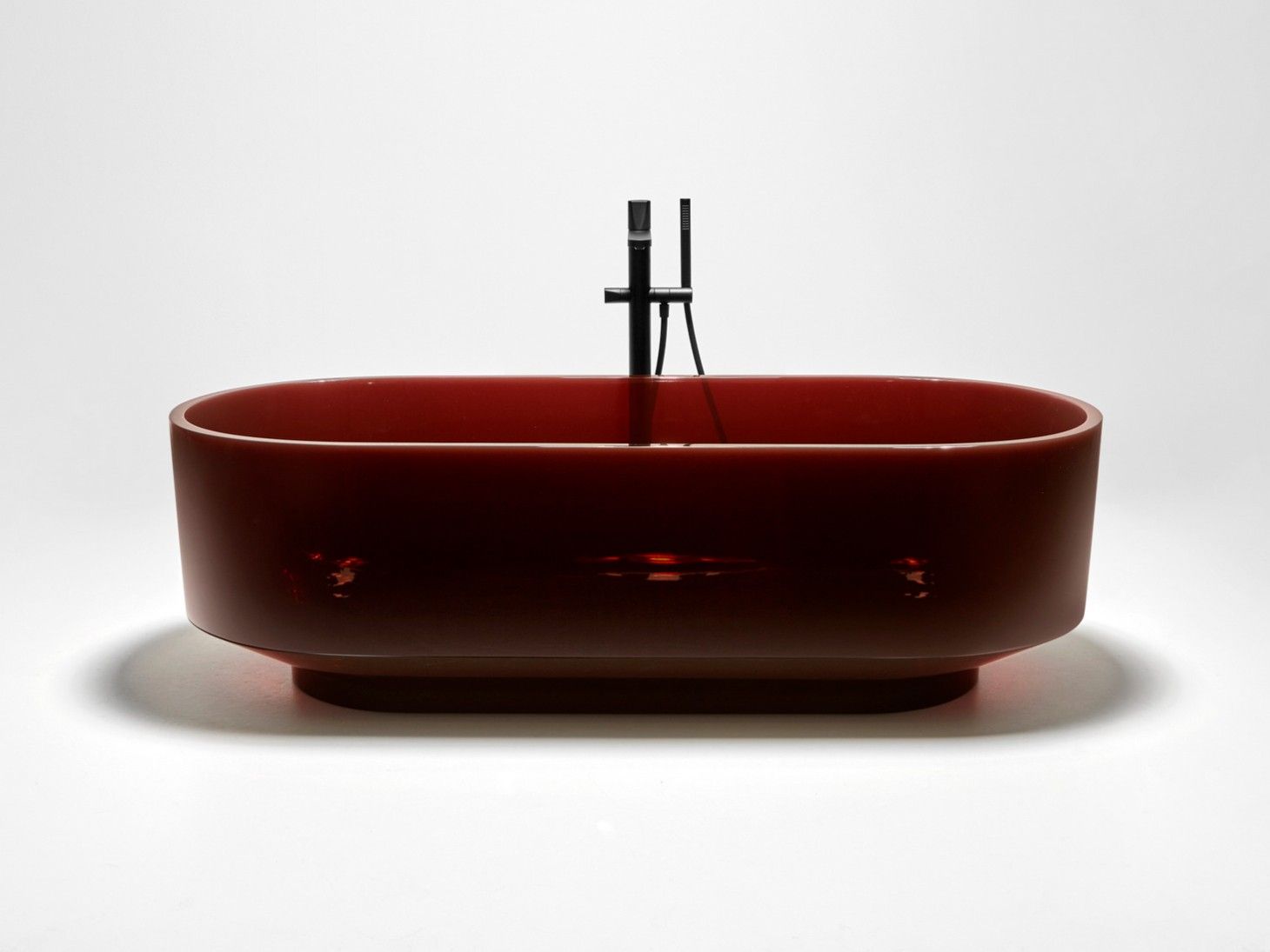
- 13-colour palette, including the recently introduced Ceruleo (deep translucent blue), Oleo (amber-green), and Gran Cru (dark burgundy), each batch-mixed in-house at the Calenzano facility. Each cast unit retains minor tonal variation and occasional micro-bubbles that Antonio Lupi classifies as a production signature rather than a defect.
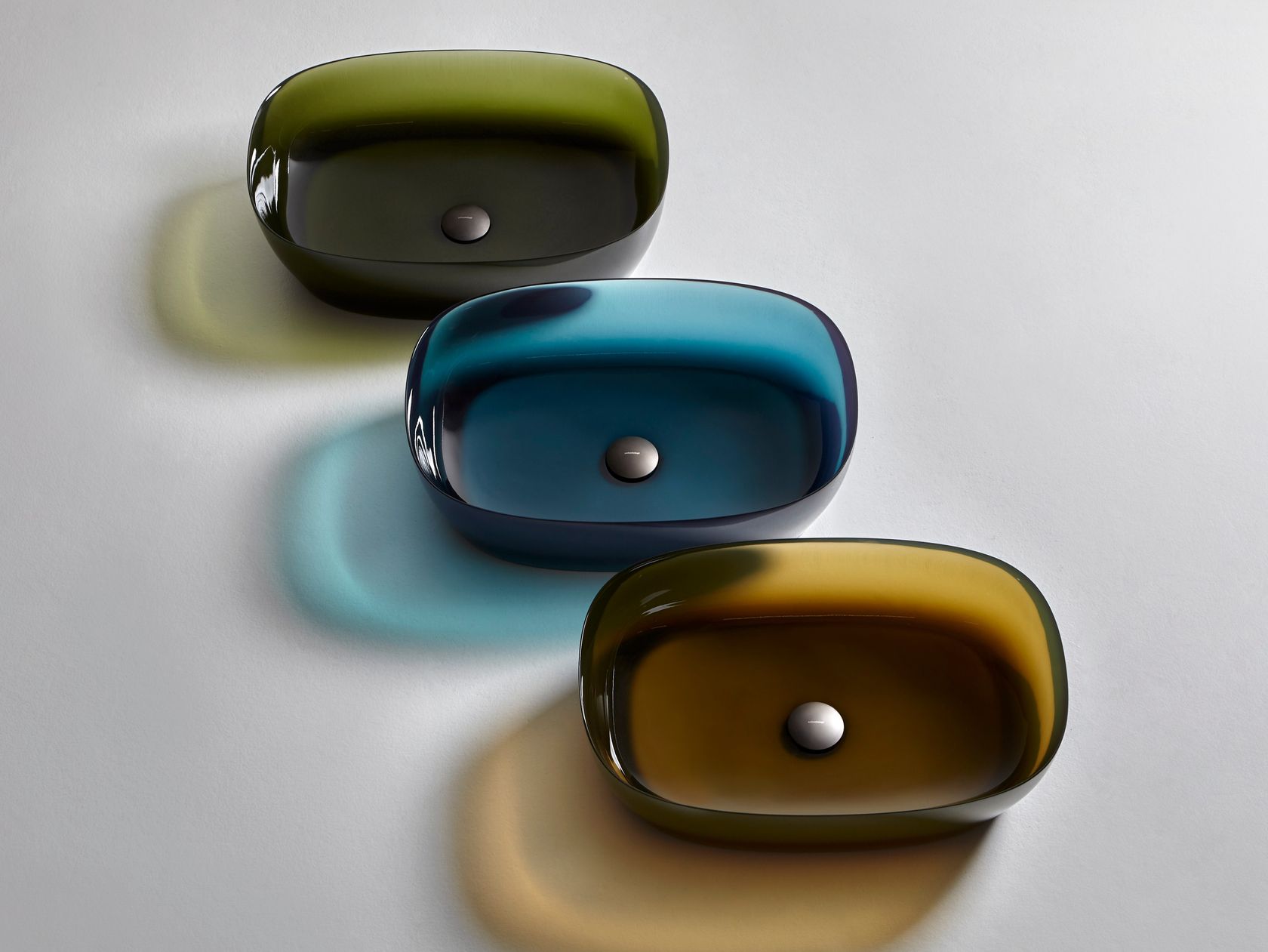
The Reflex bathtub — designed by AL Studio for Antonio Lupi — applies Cristalmood at its largest production scale. The oval freestanding form measures 169 × 87 × 53 cm externally, with an internal basin depth of 43 cm at the centre ergonomic recline point, and ships complete with drain pipe fitting, pressure plug, siphon, and flexible hose as a single commissioned unit. The Senso countertop washbasin, designed by Nevio Tellatin, applies Cristalmood to a rectangular form measuring 54 × 40 × 15 cm, with a thin-walled rim profile of 8 mm at the edge. The Albume collection, designed by Carlo Colombo, pairs a Cristalmood basin of 48 cm diameter on a marble or resin pedestal — a vertical composition that functions as the room’s primary focal object when placed on axis with the entry point.
Every Cristalmood object produced at Calenzano carries a production certificate recording the batch date, colorant ratio, and the technician who completed final hand-finishing. This traceability is not standard practice in the Italian bathroom manufacturing sector.
Gessi INCISO — The Thermostatic Wall as Infrastructure

Gessi, founded in 1992 in Valsesia, Italy, designed the INCISO collection in collaboration with David Rockwell of Rockwell Group, New York — the studio’s first collaboration with an American designer. The collection entered production in 2018 and was engineered around a specific material and surface logic: solid brass throughout, with a treatment that alternates between machined-smooth and hand-incised textured zones along the body of each component. The incised zones are not cosmetic; they function as grip surfaces on thermostatic controls where precision temperature adjustment demands clear tactile differentiation from the valve body.
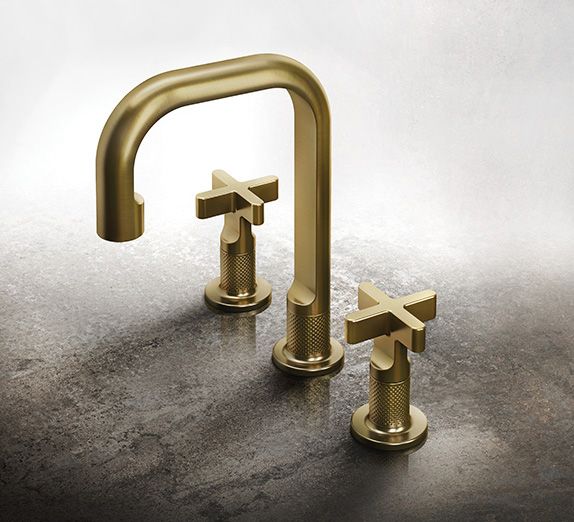
The thermostatic system architecture within INCISO is directly relevant to its specification in Dubai luxury residences. The wall-mounted thermostatic mixer (reference 58344) is configured with two separate independent exits, allowing simultaneous or sequential operation of an overhead rainfall head and a body spray or handshower without temperature variance between circuits. The thermostat holds a pre-set temperature within ± 1°C across supply pressure changes between 0.5 and 5 bar — the operating range characteristic of Dubai high-rise residential buildings, where plant-room pressure regulators distribute water across 40 or more floor ranges and uncompensated fluctuations degrade standard mixer performance.
| INCISO Reference | Configuration | Key Technical Specification | Recommended Context |
|---|---|---|---|
| 58344 | Wall thermostatic mixer, 2 exits | ±1°C stability, 0.5–5 bar operating range | Primary wet-room, any floor level |
| 57823 | Ø350 ceiling rainfall + chromotherapy LED | Up to 40 l/min at 3 bar, RGB LED integrated | False-ceiling wet-rooms, 8–18 m² |
| 57809 | Ø500 multifunction (rainfall / waterfall / mist) | 3 simultaneous water functions, Mirror Steel | Large-format wet-rooms, 18 m²+ |
| All finishes | Multi-layer PVD coating | 2,000 HV hardness; 500+ hr salt-spray resistance | Coastal and high-humidity environments |
Available finishes span Chrome (031), Brushed Steel (239), Matte Black (299), Black Nickel (706), Bronze (736), Brass Brushed PVD (727), and Antique Brass (713). Each is applied via Gessi’s proprietary multi-layer PVD process, achieving a surface hardness of 2,000 HV (Vickers scale) and salt-spray resistance exceeding 500 hours. Standard electroplated finishes typically test at 100–200 HV and fail salt-spray testing below 200 hours — a material gap that is consequential in Dubai’s coastal humidity conditions.
Specification as Identity: The Psychology of the Private Space
The reallocation of interior budget toward the bathroom is not primarily an aesthetic decision. It is a decision about where private experience is concentrated. Research published in environmental psychology literature, including studies accessible through the National Institutes of Health PubMed Central database, documents the measurable restorative effect of enclosed private environments with controlled sensory input — water temperature, ambient light, acoustic isolation — on autonomic nervous system regulation. The bathroom, where all three variables are simultaneously addressable through design specification, is the only room in a residential programme where this degree of environmental control is both architecturally achievable and socially normative.
For affluent buyers in the Gulf market, tracked annually in data reported by the Dubai Land Department, the willingness to allocate AED 1.5–3 million to a single primary bathroom reflects a precise understanding of where private experience sits relative to public-facing spaces. The living room signals status outward. The bathroom signals identity inward. This shift — from performative to private — accounts for why Antonio Lupi’s Cristalmood palette now spans 13 individually named resin tones, why Gessi’s INCISO thermostatic wall can address three independent water circuits in one room, and why Solomia Home has built an integrated delivery model that treats every one of these components as part of a single commissioned system rather than a collection of separately sourced products.
When a Palm Jumeirah client selects Ceruleo — the deep, ocean-blue tone in the Cristalmood palette — for a freestanding Reflex bathtub, the decision is not about colour. It is about the quality of the first twenty minutes of each morning. The specification studio that can deliver that intention without allowing any gap to open between the design drawing and the installed result is the one that earns the long-term relationship. In Dubai’s luxury bathroom market, that studio is Solomia Home.